Hantavirus Risk Perspective
Hantavirus pulmonary syndrome carries a case-fatality rate of approximately 38% once respiratory symptoms develop, per CDC — one of the highest of any disease covered in this network. CDC reports 890 cumulative US cases from 1993 through 2023. A 2026 Andes virus cluster aboard the cruise ship MV Hondius (13 cases, 3 deaths) was declared over by WHO on 2 July 2026; no US cases were linked to it.
Written and researched by Andy Wilcox · Last reviewed: September 2026
The Numbers
Update: The 2026 MV Hondius Andes virus cluster — the first shipboard hantavirus outbreak on record (13 cases, 3 deaths, ~23% CFR) — was declared over by WHO on 2 July 2026 after contact tracing across 33 countries and territories. No US cases were linked to it.
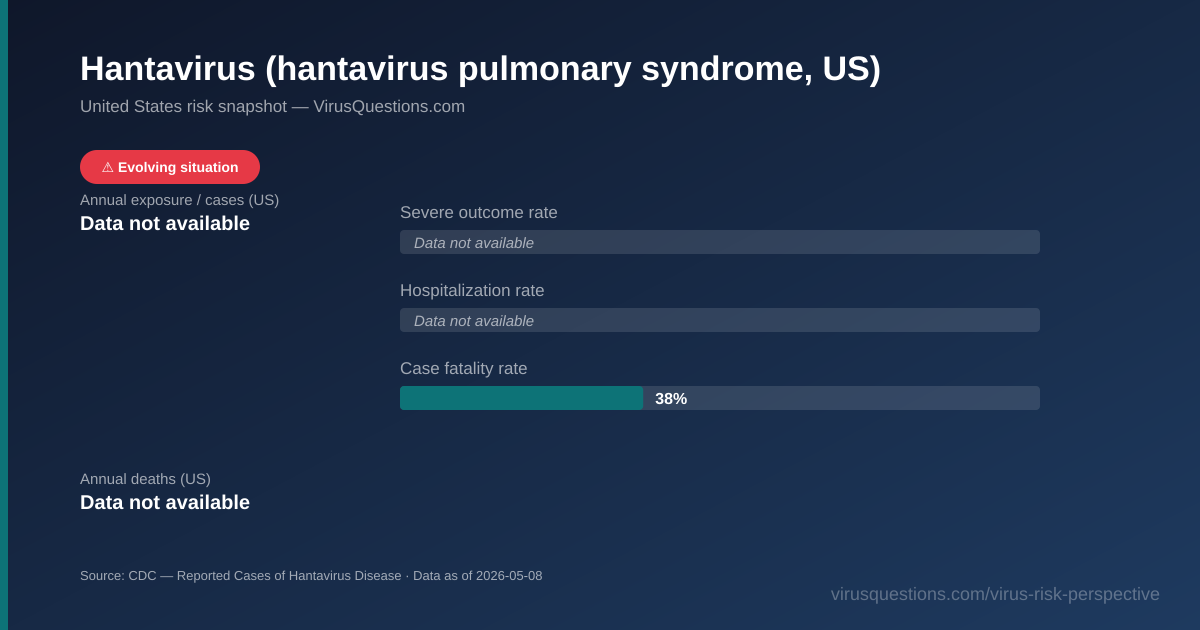
Every published figure, and where it came from
These are the figures Hantavirus is actually reported with, each shown beside the source that published it and the date it was current. They are read from a single dataset shared across this network, so a correction made once reaches every page that cites it.
| Metric | Figure | Source | As of |
|---|---|---|---|
| Annual exposure / cases | Data not available | CDC — Reported Cases of Hantavirus Disease primary source | 2026-09-15 |
| Severe outcome rate | Data not available | CDC — Reported Cases of Hantavirus Disease primary source | 2026-09-15 |
| Hospitalization rate | Data not available | CDC — Reported Cases of Hantavirus Disease primary source | 2026-09-15 |
| Case fatality rate | 38% | CDC — Reported Cases of Hantavirus Disease primary source | 2026-09-15 |
| Annual deaths | Data not available | CDC — Reported Cases of Hantavirus Disease primary source | 2026-09-15 |
CDC's own page (dated 2026-04-23) reports only a cumulative total (890 cases, 1993-2023; 859 HPS + 31 non-pulmonary), not a clean single-year annual figure, so annual_exposure_or_cases_estimate is UNAVAILABLE rather than substituting the cumulative number. CDC's weekly NNDSS tables give provisional annual HPS counts — 20 in 2024, 38 in 2025 — but year-end provisional counts are routinely revised upward by a third or more, so they are not used as an annual figure either. case_fatality_rate_pct (38%) is specifically for hantavirus pulmonary syndrome once respiratory symptoms develop. severe_outcome_rate_pct/hospitalization_rate_pct left UNAVAILABLE after a Phase B literature search: HPS by clinical case definition already involves respiratory failure, so a distinct 'hospitalization rate' may not be a meaningful CDC/literature statistic; the only figure found (67% required mechanical ventilation) came from a 12-patient pediatric case series, too narrow to represent the general population.
What is not measured, and why that matters
4 of these five metrics have no published figure for Hantavirus: annual exposure / cases, severe outcome rate, hospitalization rate, annual deaths. Rather than estimate them, borrow a number from a different population, or present one study's result as a general rate, they are left empty.
This is worth understanding before comparing Hantavirus to anything else: an empty figure is not a low one. It means nobody has published the measurement. Read as zero, it would make the least-studied diseases look like the safest.
Beyond the United States
WHO estimates 10,000 to over 100,000 hantavirus infections worldwide each year, with the largest burden in Asia and Europe — where the illness is haemorrhagic fever with renal syndrome (HFRS), carrying a case-fatality rate of under 1% to 15%. The Americas (including the US) report only hundreds of cases a year, but of the more severe hantavirus pulmonary syndrome (HPS/HCPS), whose case-fatality rate runs about 20–40%. Because the worldwide total mixes these two clinically distinct syndromes, WHO publishes no single comparable annual global figure, so the global cells are left unavailable; the US column above is HPS-specific.
Compare Hantavirus against 14 other viruses →
How these sources are tiered, and why a calculated figure is never rated above its weakest input →
Figures this site tracks beyond the shared dataset
- Cumulative US cases (1993–2023): 890 — 859 HPS plus 31 non-pulmonary
- Cumulative US deaths: 309 (34.7% — our calculation from CDC's case file)
- Provisional HPS cases, 2024: 20 · 2025: 38 · 2026 to week 35: 10
- The Americas, 2025 (PAHO, to week 47): 229 cases, 59 deaths, 25.7%
- EU/EEA, 2023 (ECDC): 1,885 infections, 3 deaths — the kidney form, a different disease
Sources: CDC — Reported Cases of Hantavirus Disease (page dated April 23, 2026) and its underlying patient-level case file; CDC NNDSS Weekly Data (rows updated September 9, 2026) for the provisional annual counts; PAHO Epidemiological Alert, 19 December 2025; ECDC Annual Epidemiological Report for 2023. All figures read September 15, 2026. CDC publishes a cumulative total rather than a clean single-year count, which is why the shared dataset leaves annual cases unavailable rather than substituting this figure; the NNDSS counts above are provisional and are routinely revised upward.
Case counts and mortality data on this page are sourced directly from CDC as cited above. This is statistical and educational information, not medical advice or a risk assessment for any individual. Figures change as CDC updates its surveillance data — check the "data as of" date and linked source for the latest numbers.
Compare hantavirus against 14 other viruses on the Virus Risk Perspective tool →
Why Hantavirus Is So Lethal Once It Takes Hold
A 38% case-fatality rate is among the highest of any disease in this network. Three features of hantavirus pulmonary syndrome (HPS) explain it — all documented by the CDC:
- A rapid cardiopulmonary phase. After 1–8 weeks of flu-like early symptoms, HPS can progress within 4–10 days to fluid flooding the lungs and cardiogenic shock. The window to escalate care is short.
- No approved antiviral, and no vaccine licensed in the Americas or Europe. There is no specific treatment for hantavirus infection; care is supportive only — oxygen, mechanical ventilation, and in severe cases ECMO. Nothing shortens the illness or halts its progression.
- Late, difficult diagnosis. Early HPS is easily mistaken for influenza, and testing within the first 72 hours of infection is often inconclusive — so treatment frequently begins only after the dangerous phase is under way.
Read the 38% correctly. It is the fatality rate once respiratory symptoms develop — not a per-exposure risk. Hantavirus is rare (890 U.S. cases from 1993 through 2023, per CDC; CDC's own surveillance analysis puts annual incidence at 0.04 to 0.19 cases per million people), and most people who take basic rodent precautions are never infected. The number describes how dangerous the disease is when it strikes, not how likely you are to catch it.
There is a second reason to read the figure carefully: the same word covers two different diseases with a two-hundred-fold difference in lethality. Hantavirus pulmonary syndrome in the Americas kills roughly a third of diagnosed patients. Haemorrhagic fever with renal syndrome in Europe and Asia — caused by hantaviruses of the same genus — killed three of 1,885 reported EU/EEA cases in 2023, a reported rate of 0.16% (our calculation from ECDC's annual report). Any statement that begins "the hantavirus fatality rate is…" without naming a virus and a continent is not conveying information.
What Is Not Known
Three gaps sit behind every figure on this page and are worth stating rather than smoothing over. The denominator is incomplete: surveillance counts laboratory-confirmed cases that met a clinical case definition, so mild infections that never prompt testing are invisible — the non-pulmonary category has existed only since 2015 and has recorded 31 cases in nine years. Recent counts are provisional: CDC has published no finalized annual figure for any year after 2023, and its year-end provisional counts for 2022, 2023 and 2024 were each later revised upward by a third or more. And severity below death is not published: CDC gives no hospitalisation rate or severe-outcome rate for hantavirus, which is why those cells in the panel above are left blank rather than filled with a plausible estimate. A transparent blank is information; an invented number is not.
Sources & References
- CDC. About Hantavirus (38% case-fatality rate; 1–8 week incubation; 4–10 day cardiopulmonary onset; no specific treatment; difficult early diagnosis). cdc.gov/hantavirus/about
- CDC. Reported Cases of Hantavirus Disease (890 U.S. cases, 1993–2023). cdc.gov/hantavirus/data-research/cases
- WHO. Disease Outbreak News: Hantavirus outbreak linked to cruise ship travel, Multi-locations (MV Hondius; final update, 2 July 2026 — 13 cases, 3 deaths, ~23% case fatality ratio, contact tracing across 33 countries and territories, outbreak containment confirmed). who.int/emergencies
- CDC. NNDSS Weekly Data (provisional weekly and cumulative hantavirus counts by state; rows updated September 9, 2026). data.cdc.gov dataset x9gk-5huc
- Pan American Health Organization (PAHO). Epidemiological Alert: Hantavirus Pulmonary Syndrome in the Americas Region, 19 December 2025 (229 cases, 59 deaths, eight countries, through EW 47). paho.org
- European Centre for Disease Prevention and Control (ECDC). Hantavirus infection — Annual Epidemiological Report for 2023 (published March 2025; 1,885 cases, three deaths). ecdc.europa.eu
- MacNeil A, Ksiazek TG, Rollin PE. Hantavirus pulmonary syndrome, United States, 1993–2009. Emerg Infect Dis. 2011;17(7):1195–1201 (annual incidence per million; case-fatality by demographic group). doi:10.3201/eid1707.101306 · PubMed 21762572